
Alto Warrant Checks
Begin with whatever paper sparked the worry. An Alto citation points to the municipal route, while a notice from a county court points somewhere else. Collect just what an office needs to pull the right file. Then ask for the current status and the next step in the process.
- Read the citation, court notice, or bond paper and identify the named court and issuing agency.
- Collect the legal name, date of birth, citation or case number, court date, and approximate event date.
- For an Alto traffic or ordinance case, call the Alto Police Department and ask for municipal-court clerk routing.
- For a Banks County warrant, contact the Banks County Sheriff and then the court named in the file.
- Before traveling, ask whether an appearance could lead to custody and speak with a Georgia defense lawyer when legal advice is needed.
Georgia has no single public warrant database. State guidance points existing-warrant questions to the local sheriff, but that county route cannot replace the town clerk for an Alto municipal citation. A phone answer has limits too. Ask what proof of identity or in-person visit the office requires before it will tell you anything.
No Online Alto Warrant List
Alto publishes no searchable warrant roster, citation portal, current court calendar, or warrant-status form. That gap matters more than it looks. A failed web search, or an empty third-party result, cannot prove that no Alto warrant exists.
Quick answer: Alto publishes no online warrant lookup. Use the citation, then call the police or the municipal-court clerk.
Ask the office point blank whether it can confirm a bench warrant, an order for arrest, or a failure-to-appear entry. If the trouble traces to a county criminal event, ask the Banks County Sheriff's Office about a current law-enforcement record instead. Note what each answer covers. It reaches only that office and the identifiers you supplied.
Policing and Courts in Alto
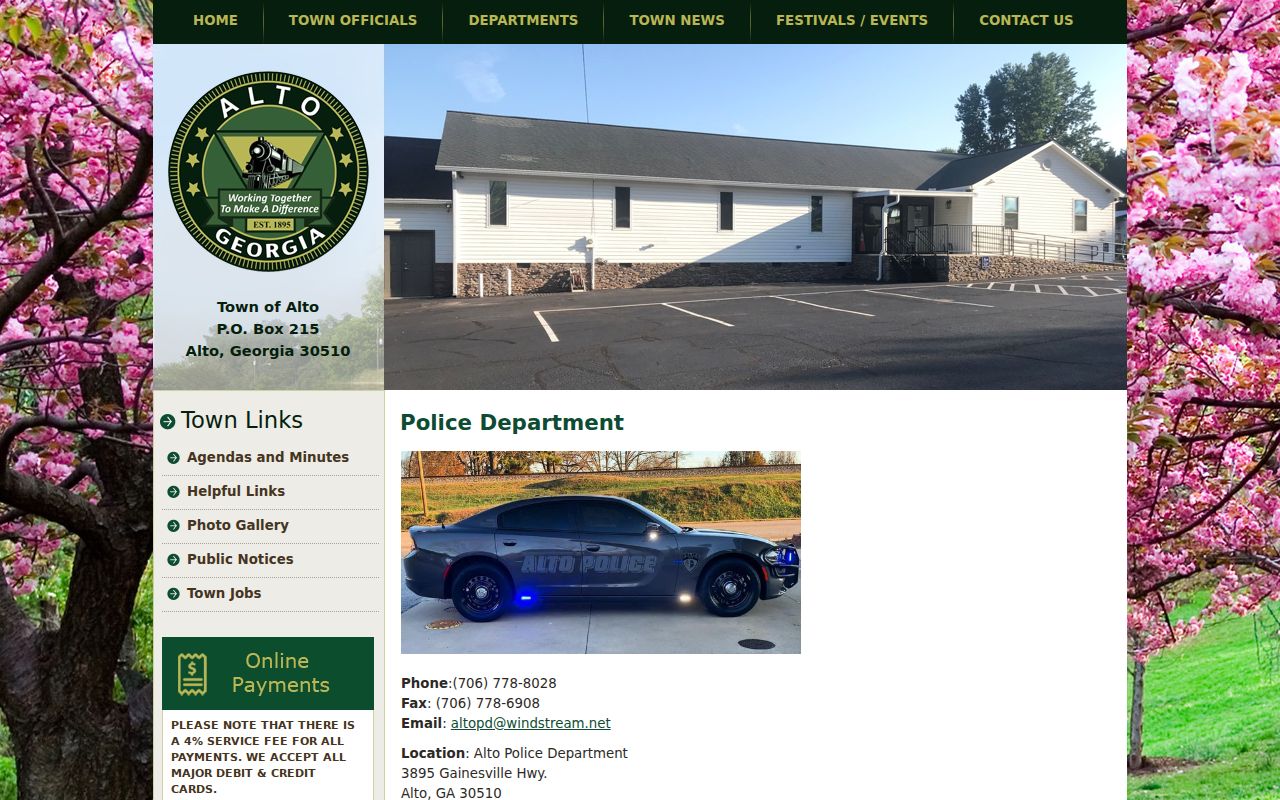
The Alto Police Department serves as the town's published contact for police routing and municipal-court clerk access alike. Its public page names Chief Sean Rogers and municipal-court clerk Karen Roy in their roles. A municipal judge controls any order entered in a city traffic or ordinance case. Police handle the law-enforcement side of that same city process.
Alto Police Department
3895 Gainesville Highway, Alto, GA 30510
Phone: 706-778-8028
Fax: 706-778-6908
Email: altopd@windstream.net
Alto Municipal Court Clerk
Use the police department contact to reach the published clerk role for a town citation, court date, public file route, or procedural status question.
The clerk can explain public procedure and whatever status the court may disclose, but she cannot give legal advice. Police can route a records question and speak to law-enforcement procedure, though they cannot change a judge's order. Call before you go. The town publishes no current clerk hours and runs no safe-surrender program.
Alto History Forms Are Not Warrant Checks
Alto's police page links law-enforcement forms along with a criminal-history consent or inquiry form. To someone worried about a warrant, those labels look promising. But a criminal-history report and an active-warrant confirmation answer two different questions.
| Route | Purpose | What it cannot prove |
|---|---|---|
| Municipal-court clerk | Checks the town citation or court event | Every county or state record |
| Alto police contact | Routes city police and status questions | That a judge has recalled an order |
| Criminal-history form | Requests a separate history product under its own rules | Current Alto warrant status |
| Open Records form | Requests a defined existing document | A real-time no-warrant certificate |
Do not file the criminal-history form hoping it doubles as a live warrant check. It does not. Use the clerk and police contact for an Alto case. Say plainly that you are trying to resolve your own matter or help a family member with theirs.
Warrants in Alto: The Main Types
Follow the issuing office's own wording. Banks County and Georgia materials commonly say "bench warrant," "order for arrest," and "failure to appear." Alto's ordinary traffic label has not been shown to be "capias pro fine." Repeat the term printed on the citation or court notice when you call.
| Warrant type | How it may arise | First official contact |
|---|---|---|
| Traffic FTA order | A required Alto traffic date or response was missed | Alto municipal-court clerk |
| Ordinance bench warrant | A city-code case duty was not met | Alto municipal-court clerk |
| Arrest warrant | A judge found the legal basis required in a criminal matter | Issuing court and serving agency |
| Search warrant | A judge authorized a search of a described place, person, or item | Record custodian when disclosure is lawful |
A search warrant is not a sign that anyone is wanted for arrest. A warrant application is only a filing stage until a judge acts on it. Whatever the type, "active" is a live status. The responsible court or law-enforcement agency must confirm it.
An Alto Citation Sets the Route
Say an Alto resident digs up an old traffic citation and cannot tell whether the date has passed. Paying some amount found elsewhere, or driving straight to a police office, is the wrong first move. Instead, read the court name, citation number, issuing agency, and scheduled date. Then call the published Alto contact.
- Ask the clerk to confirm that Alto Municipal Court owns the citation.
- Ask whether the date is current, missed, reset, or otherwise changed.
- Ask whether a failure-to-appear entry or judicial order exists.
- Ask what appearance, payment, filing, or counsel-assisted step is available.
- After action is taken, request written proof and confirm the update reached law enforcement.
Alto posts no online payment procedure, fee schedule, bond amount, warrant-recall form, or surrender instruction. Rules from Baldwin or Banks County Probate Court do not carry over to an Alto case. Follow whatever court the citation itself names.
Alto Warrant Records: What They Show
With no warrant-list screen published, Alto has no fixed display or numbering pattern to lean on. A clerk or records response may string several items together: a citation, a scheduled event, a judicial order, and a later recall. Ask which entry shows the present status.
| Local identifier | A citation, case, or warrant number, recorded as ALTO-LOCAL-NO. rather than a guessed numeric format. |
|---|---|
| Subject name | The legal name plus only the matching detail needed to distinguish the file. |
| Alleged offense | The traffic, ordinance, or criminal allegation, not a finding of guilt by itself. |
| Issuing court | The judge or court with authority to change its own order. |
| Amount or bond | Only a current figure confirmed by the court, since Alto publishes no schedule. |
| Status and dates | The issue, service, recall, satisfaction, or release entries available in that record. |
Match the court, number, and event date before you act. An old copy can stay public after an order changes. A new or restricted record may never reach an ordinary response.
Alto PD Open Records Route
The official Alto Police Department page posts an Open Records Request form beside its public contact details. Use it for a defined existing town police record, like a report tied to a known incident date or local number. Keep the date range narrow. If some material is withheld, request the non-exempt portion.
Alto handles records requests through direct contact and forms rather than a name-search portal. Expect a wait. Keep the confirmation and its date. A document request never replaces a same-day status call. A good request names the record, the event date, the agency, the citation or case number, and the person whose own matter is being checked. Leave out Social Security numbers and private details. If the sheriff holds the record rather than the town, use the Banks County Sheriff Open Records page instead of the Alto form.
Alto Warrants and Banks County
An Alto traffic or ordinance matter stays in the town process unless the citation says otherwise. County warrants are different. A Banks County warrant belongs to the sheriff and the issuing county court. Magistrate Court handles the warrant stage, while a transferred felony record may later surface through the Banks County Clerk of Superior Court in the Mountain Judicial Circuit.
Warrant flow: Alto Municipal Court or Police › responsible sheriff › issuing county court when the matter moves beyond the municipal lane.
Georgia has no single statewide public warrant search. GCIC stays inside law enforcement. Georgia Felon Search covers convictions, not live warrants. DDS deals only with the license consequence that follows some traffic failures to appear. The Banks County warrant records overview gives the full county route, so for Alto, keep the city citation and its issuing court at the center.
Alto Departments Clarify Warrant Routing
Alto sorts its town work into separate offices: Police, Probation, Town Hall, Animal Control, Public Safety, and Public Works/Water. The official Alto departments page lays out that split. Knowing it keeps a warrant question away from a department that holds no such record.
| Police | Public contact for Alto law-enforcement records and municipal-court clerk routing. |
|---|---|
| Municipal court clerk | Procedure and file questions tied to a city citation or court event. |
| Probation | Only a probation matter when that office is named in the person's paperwork. |
| Town Hall | General department routing, not live warrant confirmation. |
The official Alto departments page lists Police, Probation, Town Hall, Animal Control, Public Safety, and Public Works/Water separately. That split matters. It keeps a warrant question away from a town service with no control over the record.
Accessing Alto Warrant Records
The Georgia Open Records Act, O.C.G.A. §§ 50-18-70 et seq., covers existing public agency records subject to exemptions. It creates no duty for Alto. The act requires no public warrant list. Court records may follow judicial access rules instead, and the act answers no legal questions.
Key rules:
Georgia Open Records Act guidance explains access to existing public records and lawful limits.
Pending investigations, confidential sources, protected personal data, and law-enforcement techniques may be withheld or redacted under applicable law.
Juvenile, sealed, and otherwise restricted court material is not made public merely because an adult warrant record may be available.
Ask the custodian to cite the legal basis for any denial or redaction and to release whatever non-exempt material can reasonably be separated. A lawful copying or administrative charge may apply, and Alto publishes no municipal warrant-copy fee. Get an estimate first. When records arrive, keep the original response and its delivery date. Match the number, court, issuing agency, and dates against the citation. Then call the Alto office or the responsible court for present status. A document can be accurate for its date. It may still no longer describe an active order.
Confirming an Alto Warrant Resolution
A payment, appearance, reset, bond, filing, or attorney action may address the event behind an Alto order. None of it proves recall. The warrant stays live until the issuing court says otherwise. The serving agency keeps only its own operational record.
- Confirm the court, local number, alleged offense, and current order before acting.
- Ask the clerk what procedure is available and whether a judge must approve it.
- Use counsel when custody, bond, or plea consequences require legal advice.
- Obtain a receipt, stamped filing, or signed order after the required step.
- Ask when and how the court sends a recall or release to police or the sheriff.
- Recheck with both offices and retain the names, dates, and written proof.
Call before appearing in person. Alto publishes no current surrender or recall instructions. Georgia's state guidance warns that an in-person warrant inquiry can end in immediate custody. A lawyer can advise on the safest lawful response, while the clerk and police explain official procedure and public status. If a traffic failure to appear also reached Georgia DDS, ask whether the court sent the release that separate license process needs. Clear DDS status proves nothing about an Alto warrant. Removal from an old record view proves even less. It does not show the court closed every related matter.